Hire the Best People with Behavior Based Interviewing Training

Hire the Best People with Behavior Based Interviewing Training

The resume and experience of someone only tells you half the story. When hiring new people the most important thing to keep in mind is whether the person will be able to work according to your company’s culture. All experienced managers know that having the skills on paper and the qualifications for a post is not enough for someone to work well within the company.

 That is why behavior based interviewing training is so useful for all managers and professionals that handle recruitment for a company. Being able to understand people’s behavior and what it signifies allows you to hire the people that will truly end up becoming an asset for your organization.

Why Behavior Based Interviewing is Necessary


When you hire someone you are making them a part of a team. If you watch sports you will know how important it is for a player to fit in well with the strategy and requirements of a team. There have been great players who performed horribly when they joined a new team because they didn’t fit in well with the game plan of the team. 

Every team has its own playing style and whenever the coaches and managers are looking for new players the number one thing they see is how the player will be able to fit into the vision of the team. That is also why there have often been teams that did not have any big stars but they ended up performing better than other teams. The same logic applies to hiring people in an organization. There are two basic reasons that this happens.

Every Company has a Different Way of Accomplishing Tasks


Each and every company has its own culture when it comes to work. There are organizations where a person is expected to work very hard on a specific set of instructions. These companies are managed by people who expect their workers to work within specified perimeters. If you hire someone who is not good at following each and every rule and instruction they will not be able to work well.

There are people who show their true potential when they are given a specific task. Then, there are people who only work well on open-ended tasks where they are given an objective and they have to come up with their own way of accomplishing it. These people fit in well in companies that give the minimum instructions and a lot of autonomy to the employees. Only behavior based interviewing training can help you realize what role a person will be able to play better.

The Culture of the Company Matters


An organization is by definition a group of people working together. This means that you need to hire people that will be able to fit in well with the organizational culture because only then will they be able to work with their teammates. Behavior based interviewing training allows you to assess a person’s behavior through which you can extrapolate how they will perform when they join the organization.

This isn’t information which you will be able to understand reading someone’s resume. This is information you can only gain if you know how to assess people properly. Often, people who seem to be the right fit on paper end up being wrong for your company, and people who seem mediocre on paper end up becoming the company’s biggest assets. Behavior based interviewing is the science of avoiding the former.

Get the Whole Interviewing Story, Not Just the Magic Dust

a book is open surrounded by the lights of magical dust

Job candidates are great at painting a very rosy picture of their accomplishments and their cultural fit for the open position…but only behavior based interviewing training can help you get at the whole story behind the façade.

Certainly from the resume and quick fact checking, you can find out your candidate’s job history…where they worked and for how long and with what job title. You can also learn the basics of their education. But, beyond those details, how much can you really know about their attitude, their personality, their work ethic, their values, and their ability to get along with others? These factors are what you need to uncover. You need to probe for cultural fit. With a solid background in behavior based interviewing, you and your team can dig beneath the surface to learn what you really need to know…the whole story.

Here are some research-backed areas to explore for cultural fit based upon behavior based interviewing training best practices:
  1. Eagerness to learn and improve.
    When you have an employee who is eager to learn and improve, you have an employee who has a better chance to be engaged, committed, and ambitious. Certainly these are traits that every company can benefit from. Dig into the candidate’s passion and level of curiosity for the new and unknown.
  2. Acceptance of risk.
    An employee who is willing to take a certain amount of risk is one who can deal with mistakes and learn from them. Someone who manages only the familiar and comfortable will not be a worker who stretches and innovates. Ask about what they are most and least proud of. Then probe for when they stumbled and how they handled the situation.
  3. Willingness to collaborate.
    Especially if you are a team- or matrix-based company as so many are these days, make sure your new hires know how to work well with others. Are they out for themselves or do they recognize and support the strength of a good team pulling in the same direction and helping each other toward the common goal? Ask for examples of when they cooperated with others to reach a goal…and then ask if the persons they referenced would see the situation in the same way. This gives you a check on the veracity of their story.

How to Insure Against a Bad Hire

A woman interviewer sits with a folder across from the job candidate

Behavior-based interviewing training experts do not want all of your interviews to go well.

Just think about it.  Most interviews go pretty well. Job candidates are on their very best behavior and often seem to have the perfect answers to your standard interview questions. But can you be sure they will perform as well on the job as they did in the interview?

You had better be sure. A recent study from CareerBuilder highlights the negative impact of a bad hire. The cost in dollars can be more than $50,000 according to 27% of U.S. employers. Perhaps even more costly is the loss of productivity, the decrease in employee morale and the increase in problems with client relations.

Here are some of the statistics around what can happen when you make a bad hiring decision:

  • Over a third of U.S. employers report a serious loss of productivity. It takes time to ramp new employees up to speed. When they don’t work out, there is time wasted in recruiting and training another worker. 

  • 32% of U.S. companies report that bad hires negatively affect employee morale. How? Substandard workers drag down team targets and, while they are tolerated, hardworking employees are discouraged from extra effort and feel unappreciated.

  • Nearly one-fifth of U.S. employers surveyed also spoke of the impact on client relations and sales. When customer-facing employees do not represent your company well, clients are apt to back off and look to the competition for better treatment.

The solution?  Better interviewing approaches. It takes a proven behavior based interviewing training program to teach your hiring managers and interviewer teams how to dig beneath the surface of a savvy job candidate’s replies in order to get a true picture of their values, their work ethic, their strengths, and their culture fit. Their technical skills should be easily checked by reviewing their resumes, making some calls and running them through some scenarios. But what is equally important is learning about their attitude and true behavior on past jobs. This needs to be your focus.  And only proven behavior-based interviewing techniques combined with role-plays can give you that critical predictive insight.

To have better interviews, make sure that you:

  1. Define the Job.
    Define a clear and relevant job profile with all key stakeholders that includes the metrics for success along with the critical few motivational, interpersonal and intellectual behavior-based competencies necessary to succeed.

  2. Select an Interview Team.
    For most jobs, an interview team of four people is enough to adequately cover the assigned behavior-based competency probes.  Use a larger team if it makes sense culturally to get input and buy-in from a larger audience.

  3. Pre-Screen Interview Candidates.
    Review resumes, perform phone screens and use customized hiring assessments to ensure that only qualified candidates are interviewed by the team.

  4. Use Behavior-Based Interviewing Techniques.
    Use what you learned in behavior-based interviewing training to better predict future on-the-job performance and behavior by looking for past and present evidence that they are a good match for your specific job profile and organizational culture.

Read about Donald Trump and the Ultimate Interview

Make Sure Your Interviewing Process is Fair

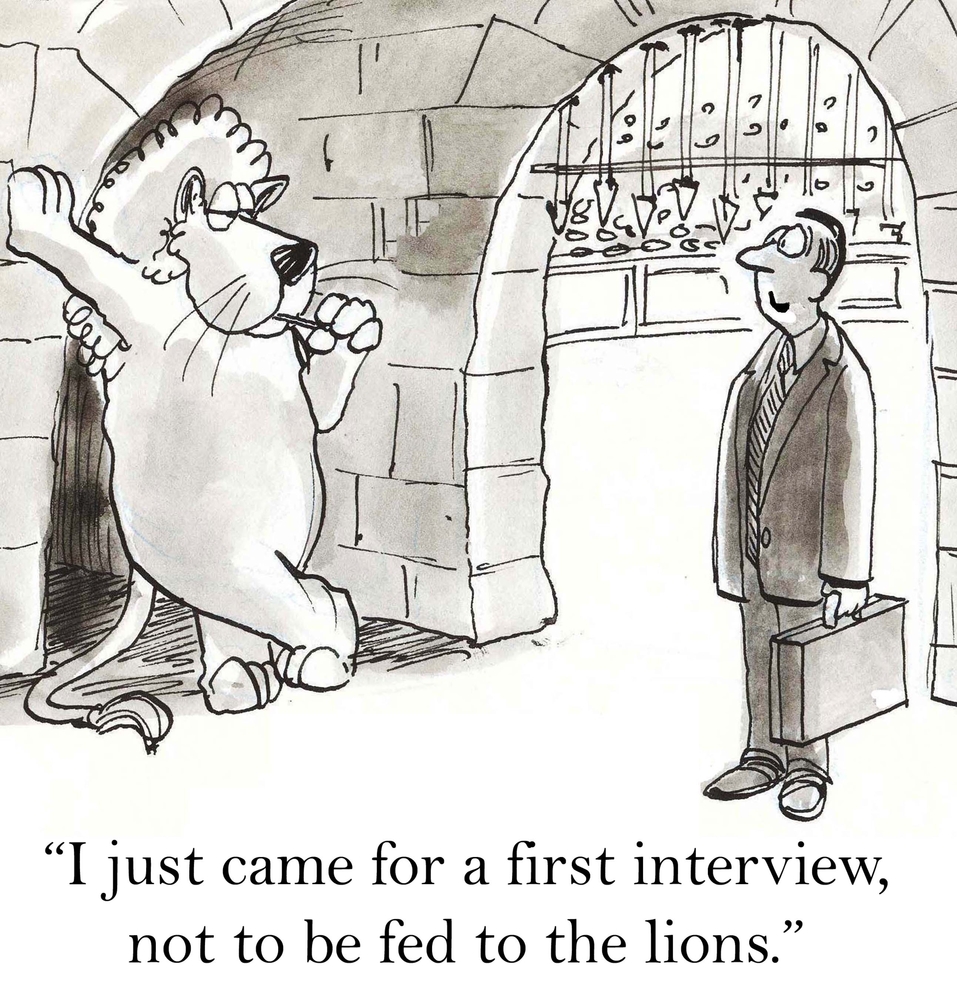
Cartoon of a businessman saying to a lion at the Roman Colosseums, "I just came for a first interview, not to be fed to the lions."

Interviewing can be very stressful for the job candidate. It may not be quite as risky a process as this cartoon suggests, but a lot rides on the outcome for the job seeker. 

Candidates need to impress the interviewer—be confident and articulate, ensure their qualifications are expressed clearly without appearing to brag, indicate their sincere interest in the position and their respect for the company, and so on. They are understandably nervous. It is your job as an interviewer to make them feel comfortable, assess their readiness and fit, ask the behavior-based interviewing questions that can predict their on-the-job behavior and ensure that the selection process is fair.

We recommend that all interviewers be well versed in what can be learned in a quality behavior-based interviewing training workshop aligned with your specific employee brand and organizational culture. Effective behavioral interviewing training teaches a competency-based process that depends upon the proven principle that past and present behavior is the best predictor of future employee performance and retention.  It typically includes:

  1. The Job Description.  The first step is to define each job in terms of the critical few behavioral competencies needed for success. 

  2. The Behavior-Based Methodology.  Then you must learn how to ask behavior-based questions (without telegraphing what you are looking for) that effectively probe beneath the surface of a candidate’s resume and rehearsed answers to uncover their true capabilities, attitudes and motivators.

  3. The Legal Boundaries.  You learn what questions are legal and compliant and what questions are not.

  4. The Hiring Decision.  Finally you make the hiring decision according to a standard and agreed-upon process that weighs candidates fairly against the parameters for success.  

Some companies rely upon candidate assessments to help with employee selection. If you use one of these tools, be wary. You need to be sure that the assessment is:

  • Legally compliant
  • Aligned with your employee brand promise, organizational culture and values
  • A proven prediction of job performance
  • Designed to provide relevant, work-based exercises
  • Creating a positive candidate experience
  • Scientifically valid and reliable

Otherwise, you are depending upon an assessment that measures the wrong things, sifts out the wrong people and may lead to accusations of an unfair process.

As anxious as the job candidate may be, job interviewers should be anxious too. They are the ones making important hiring decisions that can dramatically affect their team. Selecting top talent is a challenge. As a company leader, be sure your interviewers have the behavior-based interviewing tools and skills to do their job well.

Learn more at: http://www.lsaglobal.com/behavior-based-interviewing-training/

4 Interviewing Warning Signs that the Candidate is Not a Good Fit

4 official warning signs in black and yellow

Very few of us are really good at hiring new employees. We are all too easily persuaded that a candidate is right for the job…either because we need to fill a slot in a hurry or because we just “like” the candidate simply because they are similar to us in style. Neither of these reasons is sound. And hiring wrong is very costly…both in terms of lost time and money and also in terms of the cost to failed team dynamics.

How can we get better at such a critical task so that we hire right consistently? 

One way is to enroll all hiring managers in a proven, customized and experiential behavior based interviewing training program. This preparation for hiring right teaches techniques for how to ask the right questions to reveal a candidate’s true attitude and predict their behavior on the job. You will learn how to probe beneath the surface and uncover what does not show on the resume. You will work with colleagues to set up a proven process for evaluating candidates fairly and accurately and to test whether or not they have the competencies required for the specific job.

Meantime, you should do your best to watch out for the following four warning signs that the candidate you are considering would not be a good fit.

1. Evasive answers
When a candidate skirts your question and answers evasively, it naturally arouses suspicion that they are trying to hide something. This may or may not be the case. Just keep inquiring in various ways. Perhaps your question was misunderstood the first time or the candidate was not confident in their answer. Bottom Line: Dig until you are satisfied.

2. Inappropriate behavior or attire
If you are hiring for an executive position, your candidate should not show up in flip flops (unless you are a sandal company or perhaps headquartered in Hawaii.) And someone who slouches in the chair or chews gum loudly would not be a person you would want representing your company with customers. Bottom Line: They need to fit the organizational culture of your company, your customers and your industry.

3. Incomplete resumes
Certainly misspellings should be a warning that your candidate is not detail-oriented. But beyond this obvious red flag, are there huge gaps in their job experience or, conversely, do they seem to skip from job to job? You will need to find the story behind the job history.  Bottom Line: Mistakes or misrepresentations on the most important interviewing document say a lot about the candidate.

4. Salary discrepancy
If there is a significant discrepancy between what you are offering and what the candidate was paid in previous jobs, you should have an explanation of why they would settle for so much less. They may be trying to shift roles or find a less stressful situation…but you deserve a good reason.  Bottom Line: If things do not seem right, they probably are not right.

Learn more at: http://www.lsaglobal.com/behavior-based-interviewing-training/

The #1 Secret to Employee Retention

A giant hand reaches out to grab a fleeing employee

Want to know the number one secret to retaining your best employees? It’s pretty simple…hire right. 

When you hire the right people—those  employees who have the right competencies, the right attitude, and the right values to fit the job, the team and the organization—you won’t need to invest in any strong-arm tactics to keep them there. So…how do you hire right?

1. First you need a process…an attraction, hiring, interviewing and onboarding process that is practiced throughout the organization, not just a process outlined in the employee handbook. Establish a job profile for every job opening, select an interviewing team that, at a minimum, includes the hiring manager and critical members of the team, divide up the behavior-based competencies that need to be explored, and establish a rating system that all can use when the team reconvenes to discuss and determine next steps.

2. Probe for soft skills, not just hard. It is not just capability or experience that matters anymore. Cultural fit is critical. You need to hire people who subscribe to your organizational values and who will find a comfortable “home” in the way you do business each and every day. This is where you can rely on behavior based interviewing training to teach you and your interviewers how to dig beneath the surface of what the candidate says to how the candidate thinks, behaves and works in order to better predict how they will actually perform on the job.

3. Aim for consistency in how the organization presents itself. Keep in mind that you are in competition for the “A” players out there. Make sure that the job ads, job descriptions, and language of the interviewers are consistent with your company and employer brand. Accurately project who you are and how the company operates so you attract candidates who appreciate and look forward to joining your unique firm.

4. Assure a quality experience for the candidate. From the first screening by phone to the onboarding process for new hires, take a look at your organization through the candidates’ eyes. Think of them as customers who will talk about their experience with others. Make sure that what they say will be positive from beginning to end. It matters. 

Turnover costs big time. Increase employee engagement and employee retention by hiring right and you will see an increase in productivity and performance while strengthening your corporate culture.

Learn more at: http://www.lsaglobal.com/behavior-based-interviewing-training/

The High Cost of Hiring Low Performers

4 businesspeople sit behind a table and hold up low rating cards

Imagine this picture represents the ratings by your interviewing team of a job candidate on a scale of 1 to 5 with 5 being the highest value. There’s no question, right? This candidate needs to look for a job elsewhere. But what if the ratings averaged 3.5 or higher or are not representative of what is truly required to be successful? Are you being pressured to fill the open slot so much so that you would be tempted to hire a less than “A” talent?

Before you make a move, you should be fully aware of the high cost of hiring low performers. The costs can be divided into 5 different categories…the costs of

1. Turnover
Think about how much you invest every time you hire. Salary is just the beginning. You should calculate, too, the costs of recruiting, interviewing, onboarding and time until a new hire is fully productive. When turnover is high, you face these costs every time one person exits and there is an open slot to fill. 

2. Damage to company reputation
If you have low performing employees in customer-facing positions, you face a loss of your hard-won reputation for excellence. Don’t risk your brand with below standard workers. 

3. Culture depreciation
Low performers diminish your culture. If you allow them to stay, their presence signals a loss of accountability and alignment. When high performers work alongside poor performers for whom there are no consequences of substandard effort, they will quickly disengage and may well leave.

4. Personal devaluation
When workers are poorly matched to their job roles, they don’t enjoy their work and do not perform well. They doubt their ability and are discouraged. Their attitude can infect others negatively to the point that team members also begin to disengage.

5. Lost opportunities
Whether your company is losing potential sales deals because of poor sales performers or losing customers because your service team’s performance is lacking, you will never know what has been missed. This cost category is incalculable…both in terms of assigning real numbers and in terms of size.

So what do you do? You make sure that you hire only the best and that they are well suited to the job role, your organizational culture and your business strategy. Give your interviewing team the best in behavior based interviewing training so they can distinguish between the candidates who talk a good game and the candidates who will perform well above par in your unique environment.

Learn more at: http://www.lsaglobal.com/behavior-based-interviewing-training/

What You Really Need to Know to Hire Right

The boss at a desk says to the employee, "We love the fact you are a doer. We just don't like what you do."

So many mistakes are made in the hiring process…by candidates who accept a job for the wrong reasons and by interviewers who are not tuned in to what really works at their company. And those interviewing mistakes are costly. 

The new hires that don’t fit are unhappy, disengaged and stressed by thoughts of what it would take to leave and begin another job search. The company loses out with new employees who are not aligned with company culture or values, who are not engaged in their work, and who are likely to underperform or quit. The company pays the costs of the loss of productivity as they try to fill open slots, onboard and train new hires, and deal with the lowered morale of the workers who stay.

Hiring mistakes are much less likely to occur if you invest in proven behavior-based interviewing training. Your interviewers need to become skilled at sorting out who will fit your corporate culture and the job itself and who won’t. To do this, they need to be able to dig beneath the surface of savvy candidates who say what interviewers want to hear. What really counts is how the candidates will behave and act on the job, whether they will get along with coworkers, and how closely aligned they are with the company’s business strategy, culture and values.

Here is what you as an interviewer need to know to hire right:

1. Know what kind of organization you really are.
Yes, we know how marketing and recruiters want to portray the company in order to attract customers and top talent. But is this picture accurate? How do things get done on a day-to-day basis and what is the climate in which your high performing employees thrive? What corporate values do you actually reward and live? Answer these questions and then you will be closer to knowing what kind of employees will fit, contribute and stay. 

2. Learn from your mistakes.
Take a careful look at the employees who left. What were they looking for that they didn’t find? Perhaps they were more driven by status and power while your culture values teamwork and collaboration. Perhaps they were hoping to make a real difference in the world while your corporate culture is more focused on technical innovation than altruism. Perhaps they were thinkers who need structure while your organizational culture promotes intuitive thinking. 

Successful behavioral interviewers identify the critical few traits and attributes of their most successful employees and rigorously look for those qualities in those they hire. 

Never Stop Recruiting

A businessman is holding a sign that reads "Join Our Team"

Don’t let the “tyranny of the urgent” rule your hiring strategy. If you wait until there’s a job opening, you risk a huge loss in productivity and, if the open slot is on a sales team, a huge dent in revenue. Yes, the hiring process takes a lot of time and most sales folks resist anything that takes them away from their customers. But think of it this way…team success depends on the quality and dedication of team members. Lose or hire a top player and the consequences on team goals can be enormous.

Next, hire well.  Behavior based interviewing training can help you focus on the behavioral competencies that are necessary for success within your corporate culture and help you dig beneath the surface of a candidate to predict how they will behave on the job. With a clear list of intellectual, interpersonal and motivational competencies, a proven process for hiring, and well-trained, well-prepared behavioral interviewers, you can build the team of your dreams. 

So keep on the lookout for top performers and never stop recruiting. Maintain an active pipeline of prospects for expected and unexpected openings on your sales team. 

What Kinds of Questions Best Get Beneath the Surface of a Potential New Hire?

A huge question mark is half under water

There is a debate among interviewers about what kinds of questions are most likely to dig beneath the surface of a candidate’s thinking and experience to uncover their true abilities and attitudes. 

Some prefer the wacky questions like, “Who do you admire more…Mickey Mouse or Goofy…and why?” Others prefer to stick with the more standard queries like, “Tell me about a challenging situation at your previous job and how you handled it.” 

We see the value of both. To us, it seems a matter of what kinds of competencies you are seeking for the job opening and what type of employee would fit best in your culture. Here is our advice:

  • Off-the-Wall Interviewing QuestionsThe so-called “wacky” questions come as a surprise and a candidate is not able to prepare for them. So they test the candidate’s ability to think on their feet, show some humor and personality in their answer, and give insight into how they might react at work when the unexpected happens and they are somewhat stressed. When hiring for fast-paced, stressful and “think on your feet” environments, these questions can actually make sense when determining a candidate’s ability to perform under pressure.  

    Glassdoor recently ran a list of the top 10 oddball interview questions.  Airbnb reportedly asks “What would you do if you were the one survivor in a plane crash?”  If this question can be linked back to skills and behaviors needed to succeed at Airbnb, then it seems like a great question.  Maybe employees at Airbnb need to be resourceful, or deal with crises, or be grateful for what they have.  And Spirit Airlines supposedly asks “Describe the color yellow to somebody who's blind.”  Perhaps clear, compelling and empathetic communication is an important success attribute.

  • Behavior-Based Interviewing QuestionsThe more standard behavior-based interview questions can provide valuable insight into a candidate’s real qualifications for the job as well as their underlying values and experience. Following behavior based interviewing training, you can probe further to be able to predict how the candidate would actually behave on the job. For more structured competencies and cultural fit, this is often a better line of questioning to use.

The bottom line.  Determining a prospective new hire’s cultural and job fit is not easy.  The farther you stray from behaviors, competencies and values that actually have to do with the job, the farther you stray from finding talent that will thrive in your unique organizational culture.

Learn more at: http://www.lsaglobal.com/behavior-based-interviewing-training/

3 Steps to Finding (and Keeping) Sales Super Heroes

3 business men in super hero capes celebrate their selection through behavior-based interviewing training

There may be no team more critical to the success of an enterprise than the sales team. You rely upon them for revenue, and if they are not set up to succeed, there are few resources available to support the rest of the organization.

You want super heroes on your sales team? Here are 3 steps you should take before you even begin to source potential candidates:
  1. Be absolutely clear about what it takes to sell successfully in your business.Create a profile with specific skills and behaviors so that you will recognize the ideal candidate when find them. And remember that you need someone who not only fits the skills profile but someone who shares your organization’s values and will fit in your unique sales culture.
  2. Assemble and educate the interview team.
    P
    ut together a hiring team and make sure each member understands the specific criteria for success and their role in the hiring process. Each one should have “graduated” from behavior based interviewing training so they know how to ask the right questions that will dig deep enough to best predict on-the-job behavior. And stress that these interviews have priority. Few meetings matter more than selecting the team that will have such a huge impact on business success.
  3. Build an onboarding process and orientation plan that helps new hires be successful as soon as possible.
    H
    igh performers, the ones you target to hire, especially need to be productive quickly in order to feel and stay engaged. They are used to winning. Ensure that they are able to contribute from the very beginning be designing a new hire orientation process that improves the speed to sales productivity.
Learn more at: http://www.lsaglobal.com/behavior-based-interviewing-training/

Hiring? Remember that Good Listeners Make Good Employees


It may seem a bit simplistic but here’s the rationale behind the claim that good listeners make good employees…Active listeners tune into others and show their respect by their undivided attention. They want to truly understand what others are saying.

Isn’t this a crucial trait you want in any one of your employees? 

  • Someone who can listen well and ask the right questions in an interview. 
  • A teammate who does not dominate a conversation but invites participation of co-workers as they tackle a problem. 
  • A salesperson who is more interested in helping a customer by understanding their situation completely before offering a solution. 
  • A manager who listens to all the feedback before making an important decision.

Be sure that you highlight listening as one of the skills you seek in your behavior based interviewing training. It will serve you and your company well as you build an organization of good listeners…who know that listening first and speaking second is the hallmark of wisdom. 

Learn more at: http://www.lsaglobal.com/behavior-based-interviewing-training/

Hire Happy People. They Make Better Employees.


Does this title sound like a page from Pollyanna’s book where people with a very optimistic outlook are the ones who succeed? It is, however, true.

The fact is that if you find happy people, you are more likely to have employees who are positively engaged. It could not be more simply stated in behavior based interviewing training than to say, “Happy people make better employees.”

Here is what you gain…employees who:

·         Derive satisfaction from helping others succeed. They are good team players.
·         Want to do their best and are eager to learn how to do their job better. Continuous learning is their goal.
·         Do not waste their time and energy on toxic issues that are beyond their control like gossip or political maneuvering.
·         Avoid negative attitudes in others and focus on what is right rather than what is wrong.
·         Have a sense of humor that boosts the spirits of all on the team even in stressful circumstances.
·         Are grateful for what they have achieved in life. People want to be around them.

Regardless of the behavior-based competencies that make up your target job, do not forget to hire “happy” people who fit your unique organizational culture.

Learn more at: http://www.lsaglobal.com/behavior-based-interviewing-training/

How to Put Your Target Job Candidates at Ease


The more relaxed your job candidate in the interview, the more accurate your picture of them. 

Unless a key success criterion is their ability to perform under unexpected circumstances and pressure, there is nothing to be gained by adding to their stress. How can you relieve their anxiety so they perform at their best and you are able to assess their true potential for the job? 

Unless figuring out situations is a desired core competency, behavior based interviewing training experts recommend that you prepare interviewees for what to expect when you meet face-to-face. Tell them about the interviewing process at your company. Who and where will they meet? Who will conduct the interviews and how many people will be in the room? What is the accepted dress code? You might even tell them what topics you plan to discuss. 

The objective? Making job candidates as comfortable as possible so you have an opportunity to more accurately evaluate their fitness for the role. If they are “hot under the collar,” your conversation will be less professional and certainly less productive.

Learn more at: http://www.lsaglobal.com/behavior-based-interviewing-training/

Hiring the Right People Is Worth a Wise Investment

Hiring the Right People Is Worth a Wise Investment

Hiring the right people is like putting money in the bank for your company’s future. Just think of the return in terms of how much better things run when you have great people and, by the way, how many crises you can avoid with skilled, able managers in place.

And yet, too many executives avoid the time it takes to do it right. They may understand and accept the basics of behavior based interviewing training but do not invest the effort in truly following the process.

Good hiring requires the good sense to know that it will take the effort and commitment to execute all the small tasks involved successfully such as:

  • Defining the job in behavioral competency terms.
  • Identifying interview teams, roles and responsibilities.
  • Using a proven behavioral interviewing methodology to effectively identify a candidate's competencies and past performance.
  • Keeping all interviews legal.
  • Rating candidates with confidence.
  • Selling the job opportunity to desirable candidates.
Learn more at: http://www.lsaglobal.com/behavior-based-interviewing-training/

How to Recognize and Hire for “Executive Presence”

How to Recognize and Hire for “Executive Presence”

Executive presence is an intangible trait that can have a significant impact on the chances for success.

There are three main factors, appearance, trustworthiness and authoritative communication, which contribute enormously to an image as someone who can influence executives and advance in their career because they have what it takes to lead and influence.

If you are an interviewer, you should know how to recognize “executive presence” and then apply best practices from behavior based interviewing training to explore what lies behind the image. If you are interviewing someone for an executive position or for a role that needs to persuade executives, here is how to put their executive presence potential in the spotlight:

  • Appearance. While it may seem shallow, first impressions matter. Do they look the part? Whether you are on Wall Street and need a finely tailored suit or in a high-tech startup, be aware of the image your candidate projects with their clothes and hair style. Do they dress a “notch above” and enter a room with confidence?

  • Trustworthiness. Recent research at the Harvard Business School by Amy Cuddy suggests that trustworthiness and confidence act together to form first impressions. Does your candidate come across as warm, trustworthy, capable and competent?

  • Communication with Authority. Do they speak with authority and from a depth of knowledge and experience commensurate with their role? Are they concise? Are they compelling? Do they easily convince others that there is great depth behind what they say?
Learn more at: http://www.lsaglobal.com/behavior-based-interviewing-training/

Important Interview? Go for the Underlying Truth

Important Interview?  Go for the Underlying Truth


It’s not so much that job candidates lie as that they don’t always tell the truth.

It is up to the interviewer to keep asking the questions that reveal true attitudes and behaviors. It is your skill as an interviewer in applying behavior based interviewing training that will reveal the underlying truth. The first questions won’t do it. The skill is in how you probe with effective follow-up questions to uncover job and cultural fit.

For example, many interviewers cannot escape the old-fashioned request for a candidate to list their strengths and weaknesses. Savvy interviewees are well prepared. They will come up with an answer that reflects well on them. A strength? Their problem-solving. A weakness? Their attention to detail.

To get beyond these answers, you have to dig deeper. Find out about the implications of their behaviors. What problem did they solve? How did they accomplish this? How did it affect others on their team? What did they learn? Where did they have to go for support and resources? How did they handle nay-sayers? Did they get all the credit…why or why not?

Make sure you don’t let candidates off with easy, standard answers. Go for the gold…keep probing until you have a clear idea of how they might behave on YOUR job in YOUR unique corporate culture.


Learn more at: http://www.lsaglobal.com/behavior-based-interviewing-training/